Four Dollars Here, Sixty Dollars There: The Real Reason Your Prescription Price Depends on Where You Park
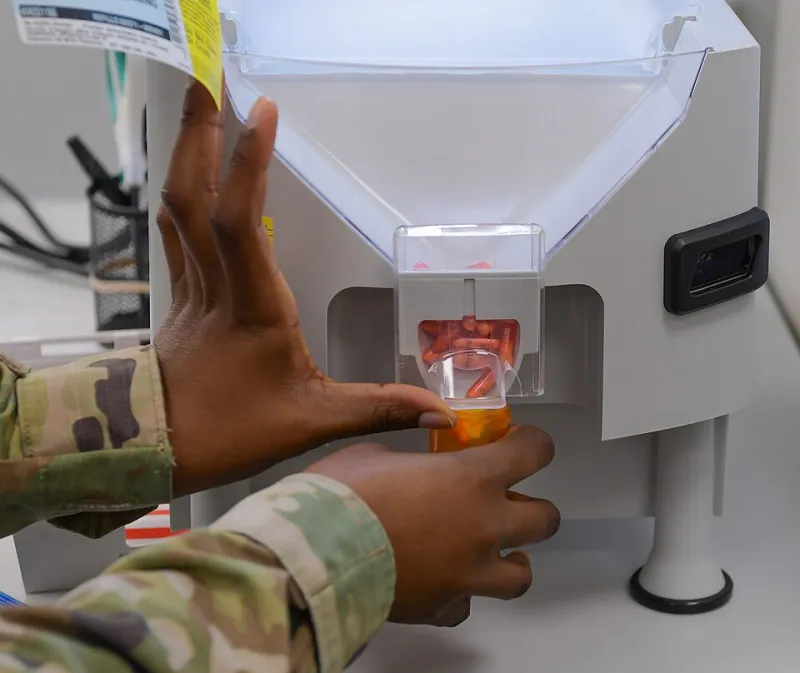
Photo: U.S. Air Force photo by Airman Trevor Calvert, Public domain, via Wikimedia Commons
Two patients in the same town can fill the same prescription for the same generic drug and pay wildly different amounts. One hands over four dollars at a national chain counter; the other is quoted fifty-eight dollars at a pharmacy less than a mile away. Neither patient is mistaken, and neither pharmacist is gouging. The American pharmacy marketplace is structured in a way that makes price a function of location, negotiation, and timing rather than the medication itself.
Why One Drug Has Many Prices
Generic medications are, in principle, commodities. The active ingredient is identical whether it comes from a large chain, an independent corner store, or a mail-order facility. What differs is everything surrounding the pill: the pharmacy's wholesale contract, its reimbursement agreements with insurers, and the often-invisible role of pharmacy benefit managers (PBMs) — the intermediary companies that negotiate drug pricing on behalf of health plans.
PBMs maintain formularies and reimbursement schedules that can favor one pharmacy network over another. A chain that has negotiated aggressively with a PBM may be reimbursed at a rate that allows it to advertise a deep discount; an independent pharmacy operating under different contract terms may have no choice but to charge more for the same refill. Add to this the well-known loss-leader programs — the famous discounted generic lists offered at major retailers — and the pricing landscape becomes a patchwork rather than a market.
The Discount Card Layer
Overlaid on this patchwork is a second economy: cash-price platforms and prescription discount cards. Services such as GoodRx, SingleCare, and manufacturer savings programs negotiate their own rates with pharmacies and pass some of that discount to consumers who pay without insurance.
This creates a counterintuitive reality many patients discover at the counter: the insured price is not always the lowest price. A copay of $25 under a plan can exceed the discounted cash price of the same drug. Federal rules now generally allow pharmacists to tell patients when a discount card would cost less than their insurance copay, but patients still often need to ask.
A practical approach:
- Before filling a new prescription, compare the discounted cash price against your copay using a price-comparison app or phone call.
- Ask the pharmacist directly: "Is there a cheaper way to pay for this today?"
- Recheck prices periodically. Discount agreements change, and a drug that was cheapest at one pharmacy last year may not be this year.
Pharmacy Deserts: When Choice Disappears
Price variation assumes patients have options. Increasingly, many do not. Closures of retail pharmacy locations across the United States — driven by thin reimbursement margins and shifting retail strategy — have expanded what researchers call pharmacy deserts: neighborhoods, often rural or lower-income urban areas, where the nearest pharmacy is miles away or has closed altogether.
The consequences extend beyond convenience. Patients in pharmacy deserts fill fewer prescriptions, delay refills, and are more likely to abandon therapy. For medications where continuity matters — blood pressure control, diabetes management, anticoagulation — the nearest pharmacy's closing can be a genuine clinical event.
Shopping Around Without Compromising Safety
Strategic prescription shopping is legitimate, but it should be done with a few guardrails:
- Keep all prescriptions at one pharmacy when clinically important. A single pharmacy record allows the software and the pharmacist to screen for drug interactions. Splitting fills across three chains can fragment that safety net — a problem covered in detail in our earlier reporting on fragmented pharmacy records.
- Confirm availability before you go. Shortages of common generics are recurring; a two-minute phone call prevents a wasted trip and an unfilled prescription.
- Use one discount card per transaction. Cards generally cannot be combined with insurance, and switching between them at the same pharmacy can create record-keeping confusion.
- Ask about 90-day supplies. For maintenance medications, a longer fill at a mail-order or preferred pharmacy often lowers the per-day cost and reduces refill friction.
- Never split short-course or urgent prescriptions across pharmacies if the delay means going without the drug for a day or two.
The Bottom Line
The price of a generic prescription in the United States is less a reflection of the drug than of the system around it. Patients who understand that system — who compare discounted cash prices, ask pharmacists about cheaper payment routes, and consolidate records where safety demands it — consistently pay less and adhere better. The four-dollar list and the sixty-dollar quote can describe the same tablet; knowing why is the first step toward never overpaying for it.
This article is for informational purposes and does not substitute for advice from your pharmacist or healthcare provider.